New Site, Who Dis?
Okay, so...
I'm redesigning this site. Again. And I'm tweaking my brand a little. Okay, more than a little (if you've watched the aesthetic changes).
Buckle up while I summarize the last eight years.
Let's rewind to 2018, when I started this whole thing as "Geek Girl Tarot".
Cute name.
Surprise plot twist: it wasn't completely accurate, since I eventually realized I'm nonbinary. The "girl" part also leaned heavily into the Girlboss™ culture at the time.
The more important issue: I had no idea who I was yet. I looked at what other folks were doing — the aesthetics, the vibe, the whole spirituality-industrial-complex — and I mimicked it right down to the professional photo shoot with the makeup artist who prepped me in advance.
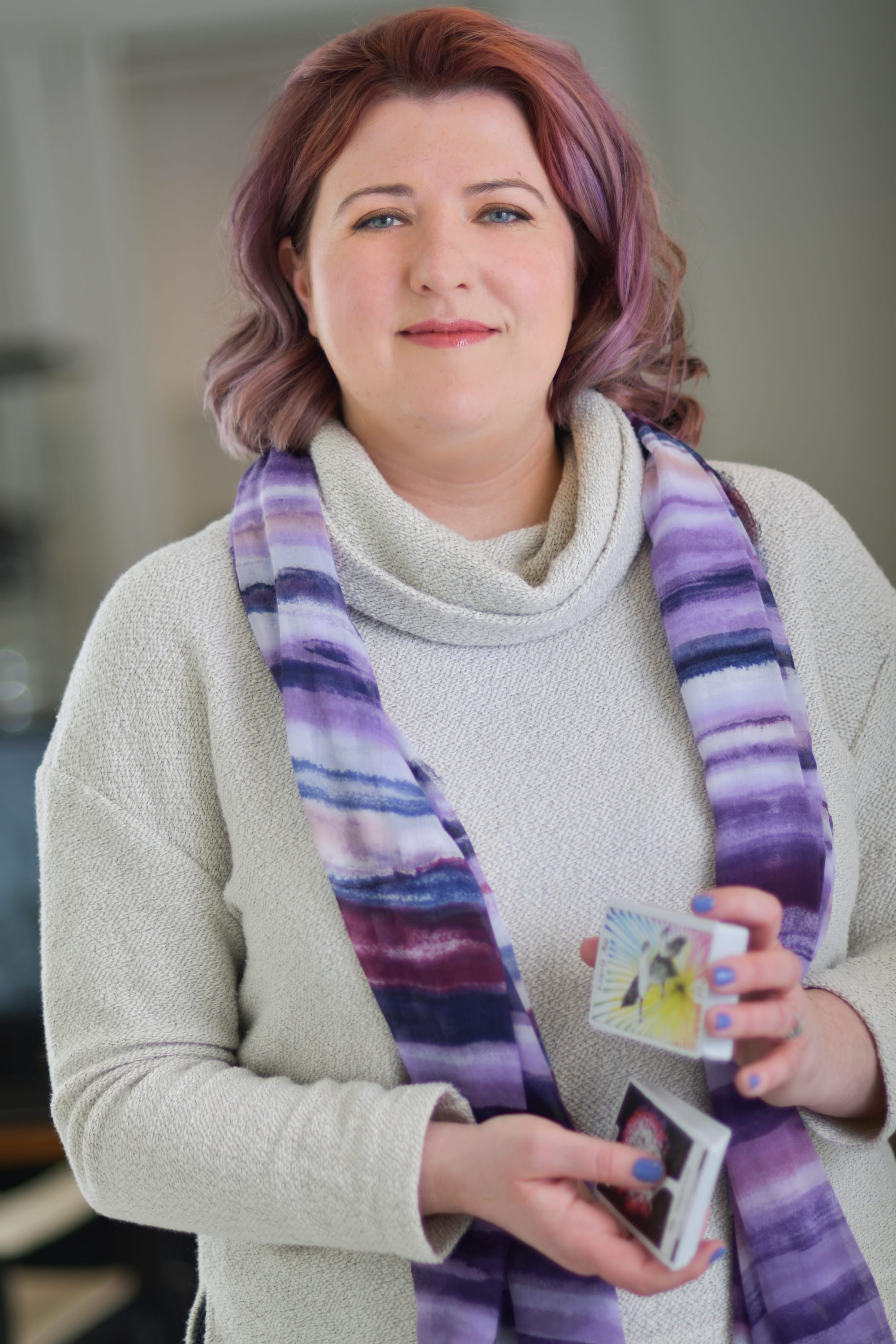
You know, the stuff you do when you don't trust others to accept the real you.
The stuff that you do to put on the "I'm doing okay" mask.
I'll be real here: yes, I've helped a lot of folks over the years and done a lot of good, but early on, I was also a hot mess.
Rather than give myself a moment to grieve some pretty huge life events, things like:
- Going in for an outpatient operation the day before my 38th birthday, getting the call from my mom (tumor removal where they had to cut to the bone), then having to take a Greyhound overnight with a bandaged foot, and spending most of my birthday worrying if I'd have a chance to say goodbye to my dad before he died. I did, and he passed away a week later.
- About two months later, losing a multi-year relationship where I had kept my head in the sand instead of seeing all the signs saying, "Mismatch! Incompatible! They're shutting down!"
- And because that person was also a business partner, and because I had been too optimistic to set up legal exit strategies, a creative project I had been working on went up in flames. For those who are curious: it was a role-playing game that used modern urban fantasy tropes to explain power and privilege in an approachable and non-academic way. Apparently, some took that endeavor to be a form of heresy.
My way of coping with all of that: to bury my grief in helping others. To take the relief I got from a Tarot reading on the situation and go, "I should do this so others can also find clarity and peace."
Again, it worked, and I helped a lot of people. But I was also a hot mess.
A lot has happened over the last nine years. I've finally learned to face not only that grief, but also a lot of the baggage that I'd been holding onto since childhood onward. You know, those early experiences that taught me "goodness" was "convenient" and "low maintenance". Where help had to feel earned. Those lies some of you might have learned too if you were the eldest child.
I also learned how to differentiate the things that I wanted to do from the activities that became more like obligatory habits - the things that you keep doing because you think you should do them to maintain others' approval.
Creative expression, theatrics, and talking mystic shit - yes
Being the load-bearing volunteer in various groups and taking part in LARPs where the community side was shallow (because the game had a backstabby, competitive element) — yeah, no. Got some amazing life skills out of those experiences, but I'm done.
I also got officially diagnosed with Social (Pragmatic) Communication Disorder, ADHD, and Anxiety (General and Social), which for me was a pretty big "ah-ha" moment. I saw how much I had done to compensate for how my brain works.
Then came the big question: "Who is Jess when they aren't focused on pleasing others; when they focus on what they enjoy and want?"
Here's what I've known since childhood but wouldn't admit: I'm weird (and that's okay!)
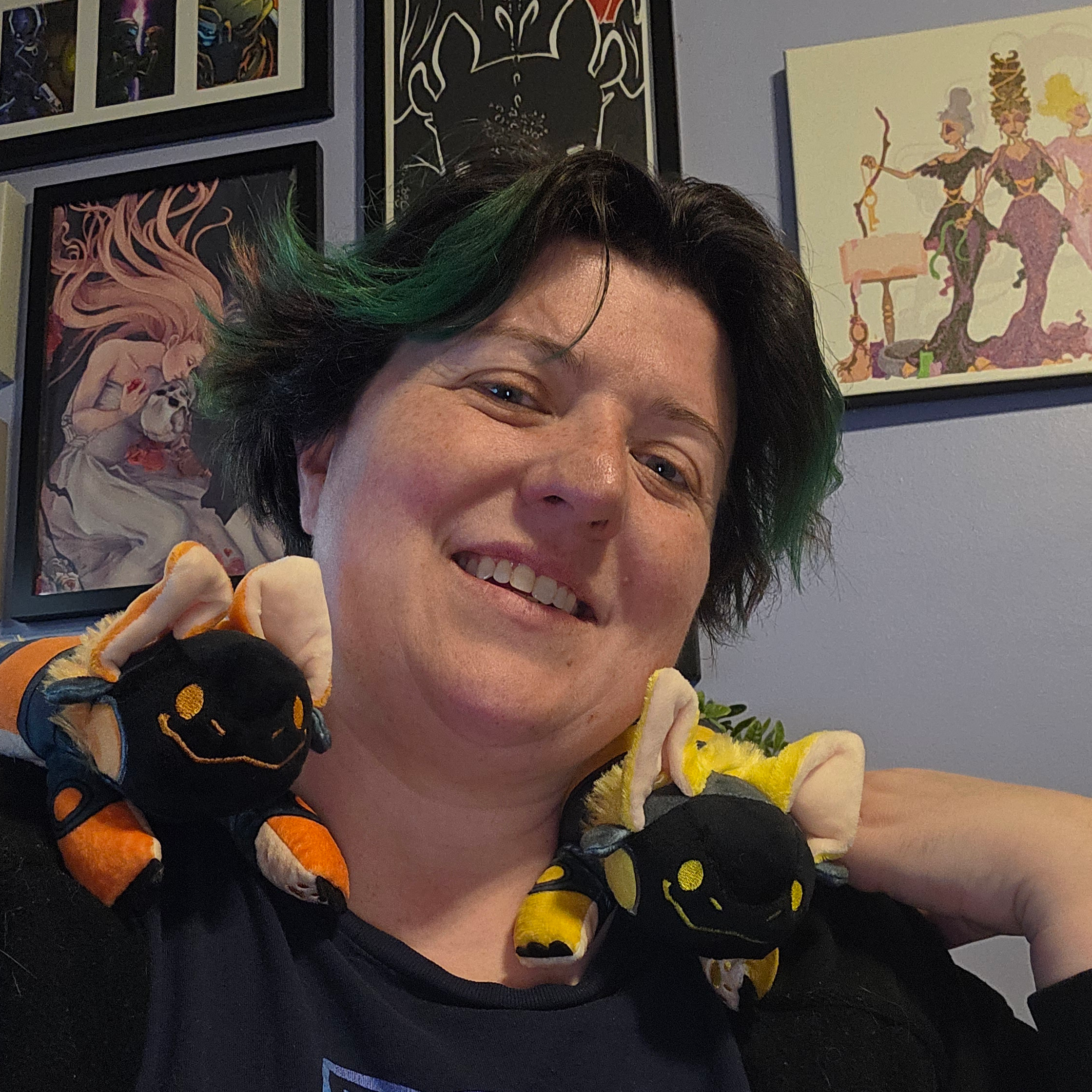
I'm a furry.
I'm into video games like Mass Effect. Actually, I'm into most RPGs where you can romance non-human NPCs.
I'm queer.
I'm neurodivergent.
I have a very dark sense of humor (enjoyed The Boys).
I see the world through the lenses of systems and power. Some of the things I nerded out on in early adulthood were how people think and what causes people to make decisions. When you take that understanding and then reflect on the injustices in the world today, it can be tough to have candid conversations with folks who want to see change.
I believe in magic. More specifically, I view magical practices as their own form of tech. Some are so heavily intertwined with a culture or practice that separating the tool from its source material is impossible. Those are what folks call "closed practices", and I don't touch those. I look at the ones that are available across different cultures, as well as systems developed by Western occultists.
Technically, I'm what you'd call a "witch". I prefer the term "technomancer".
Everything I just described — I didn't know if anyone would want all that.
Would people only show up for the softly-lit Tarot content that occasionally had a geek reference?
Or would they actually show up for the real me: the one who cross-references crystal correspondences with video game lore and has Opinions™ about how some online witchy spaces carry the same vibe as fandom communities?
Over the last several years, my business did what most solo-run businesses do: it evolved based on my wants and skills. I started making bracelets. I pulled back on in-person readings. And I realized how many communities I straddle: witches, geeks, furries, skeptics, storytellers, and those who think spirituality and tech aren't enemies.
I also have Opinions™ about Artificial Intelligence, as well as The Discourse™ around Artificial Intelligence. The latter is more interesting (and probably more controversial) because it delves into separate conversation topics like values, social contracts, and meaning-making. I see all of this as spiritually significant since it ties to how we see ourselves as individuals and collectively.
At first, I worried that showing up fully might push some folks away. Now, I realize that's the point. I shouldn't expect everyone to like me, and trying to be palatable means having lots of lukewarm fans. The ones who really like me, or really hate me (yes, spite fans exist!).
My interests and identities inform my work, so those who stick around are drawn to my weird. They get that my conversation will go all over the place, that I'm okay with not having all the answers (but still showing up), and that we won't always agree. And all of that is okay.
So let's talk about what might really raise some hackles —
My "Heresies"
We've all seen witchy content online. Here's where I diverge. I'm talking about stuff that falls into the category of "will get me removed from a Facebook witchcraft group":
Heresy #1: I side-eye some of the lore.
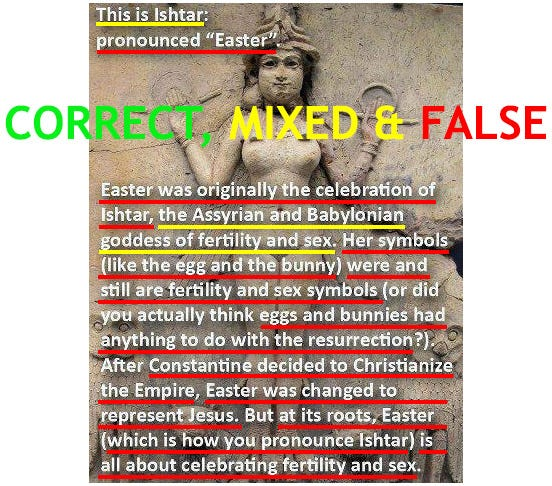
I'm a witch. I also accept that much of what's passed off as witchcraft (at least in the United States) is relatively modern: adaptations of ceremonial magic or non-European traditions mixed with theatrics and folklore.
I also minored in Theology, which meant learning the various ways a 2000+-year-old religion evolved from its roots, and how its theology changed.
Change happens. Religions can be new. Those aren't the problem. The problem is the meme-level lore. Stuff like Isis and Easter. Or claiming some historical line of succession between ancient practices and modern festivities.
I think the desire to tie modern paganism to the ancient and mythic is us reckoning with the grief of what assimilation has done: erasure of cultural traditions. It's the curse of being part of a larger group while also not feeling like you're part of something bigger. I don't fault people for going that route, but I feel that part of healing and growth is acknowledging the underlying wound rather than simply soothing it.
Heresy #2: My magic system doesn't fit neatly into a digital course or content calendar.
One thing I see over and over again is the expectation of teaching. To show you're a legit spiritual practitioner, you should share how you do things. Not to mention, social media algorithms track engagement, and one way to get eyeballs on a post is to educate.
My formula
- Accept what I can versus can't control
- See life as a combination of cause and effect with a hint of statistics
- Do what I can to improve the odds and thus improve the cosmic die roll. Sometimes, it's mundane stuff. Or psyching myself. I might do a ritual if I have time.
- Afterward, emotionally process and see how those experiences fit (or change) my paradigm
- Rinse and repeat
- Oh, and be okay with the random bit of right place/right time luck
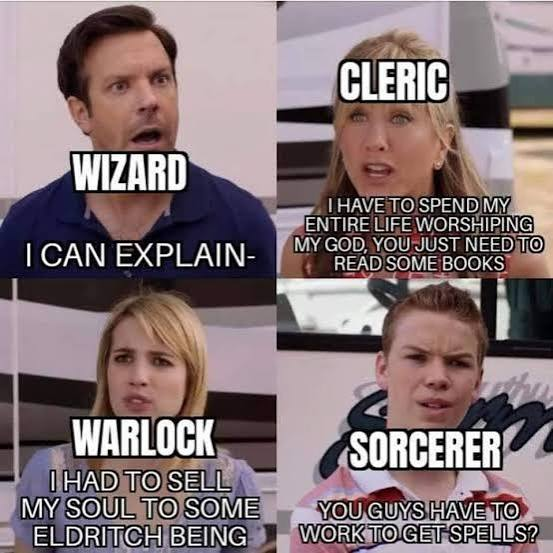
Sure, I can teach you about correspondences. What crystal or herb to use, the best astrological timing, etc. But so can everyone else with Canva and an account. I focus on the why something works; the proverbial code of the magical system. Once you reach that point of awareness, the specific tools and practices open up. The downside: having to choose what to do rather than have it prescribed to you.
I know that might be scary, and you might ask yourself: "What if I choose the wrong crystal and everything blows up?" It won't. If it did, it's because you mistook an explosive for a crystal.
Now, I'm not going the whole "only intention matters; use whatever" route (the other end of the discourse). It's a lot more nuanced and requires explaining stuff I learned through personal experience and by reading the works of various occultists. Stuff that doesn't easily translate to an infographic or tweet.
What does this mean? I might still share magical correspondence stuff (some meme'ified, some researched). Otherwise, I'll be more on the esoteric/occult'y end, mixed with game theory.
Heresy #3: I don't compartmentalize to be palatable.
Remember what I said earlier: that I'm a geeky, occultist furry with a dark sense of humor and interesting choices in RPG romance options?
Yeah, there's even more to me than that. I'm polyamorous, queer, and neurodivergent.
I'm also big into personal development, which is a part of The Work in occult practices. I've had a lot of setbacks in life. I've also experienced when things go well, and I want to share what I've learned to help others improve their odds.
In online discourse, it feels like "personal responsibility" and "social awareness" sit on opposite ends of the content spectrum. Yes, the world is systemically unfair and rigged to favor some over others. And yes, parts of who I am put me at a disadvantage for things that I can't control. You can hold space for those discussions while also talking about ways to get ahead despite that system. AND, you should be able to celebrate your wins without someone diminishing them because they don't think you suffered enough.
The fact I just said that aloud probably ruffled a few feathers.
I'm not saying I'm going to spill every dirty, TMI secret. What I am saying is that if there's a part of my identity I feel is relevant to you understanding who I am or where I stand on a topic, I'm not going to hide it.
Heresy #4: I don't play the "real witch" game.
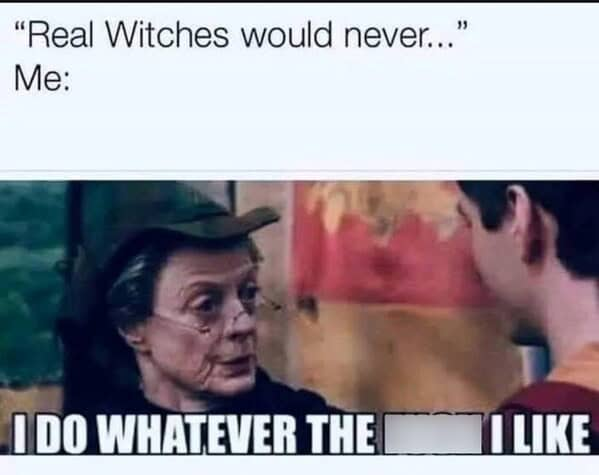
I'm done with the discourse about what real witches do — or don't do. Let's go back to what I said earlier: a lot of what's considered modern witchcraft is reinvention and re-creation, which is completely okay! The problem is how some now seek to make themselves legitimate by delineating themselves from those who aren't "real witches". They tear others down to build themselves up.
I'm very much "You do you. Just don't run with scissors."
Heresy #5: I refuse to pick an extreme side in the AI wars.
I'm not "AI is an unmitigated evil and will destroy humanity," and I'm not "AI is the greatest thing ever, and you need to adopt or get left behind."
I'm wary of evangelists on either side of this discussion — especially when they're pitching a utopia or warning of an apocalypse. I'm an ex-JW, so I'm a bit critical when someone comes at me with an extreme message. I also work with data in my day job, so I have a reflexive twitch whenever someone hangs their entire argument on a single study or dataset like it's scripture.
My actual stance: AI is a tool, and the conversation we need to have is bigger and messier than "it's good" or "it's bad." We need to talk about when and how we use this tool, and who decides what guardrails to put in place.
Also, we need to approach this conversation with empathy, since we've all been shaped by different systems. This means we each have different views on what is acceptable and when the ends justify the means.
This goes back to my fascination with how people think and what drives their decisions.